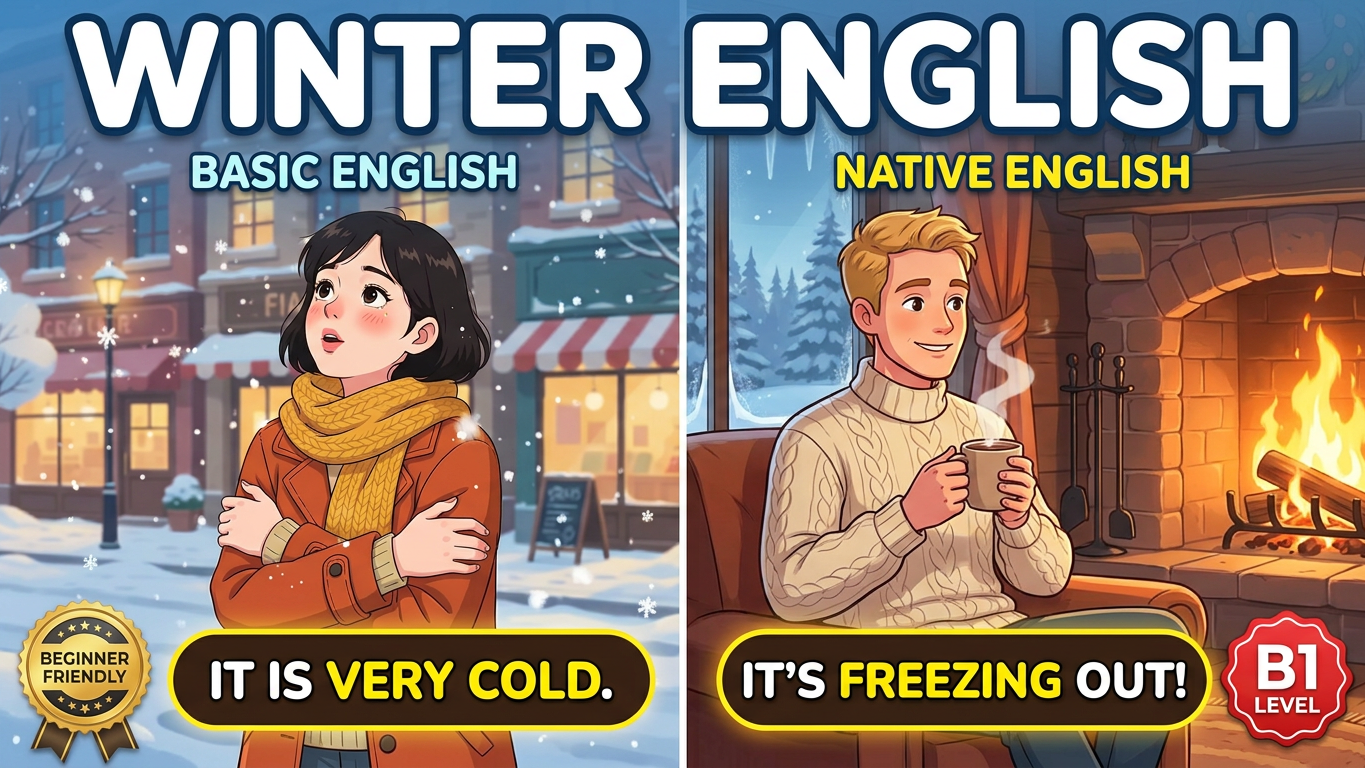
Snow falling softly. Icicles hanging from the roof. A warm fire behind you and a hot chocolate in your hands. Could you describe that whole scene in English right now?
By the end of this lesson, you will.
In our latest Simple English Daily episode, Kate and Michael walk you through more than 60 winter words and phrases — slowly, naturally, and with real examples you can use today. This post is your written companion to that lesson. Read it, say the words out loud, and keep it open the next time you watch a snowy day through your window.
🎧 Watch the full lesson: Winter Vocabulary: Speak About Winter Weather Like an English Native — about 30 minutes of slow, clear English.
People talk about winter all the time in English — the weather, staying warm, fun in the snow, cozy nights at home. Once you can talk about winter naturally, you'll always have something to say all season long. Let's begin.
1. Winter Weather Words
These are the words you need to describe the cold weather all winter long.
Word Meaning Example snow soft white flakes that fall when it's very cold "Look outside — it's snowing!" cold a low temperature "Wow, it's so cold today. I can see my breath." freezing extremely cold "Close the door — it's freezing in here." chilly a little bit cold, but not too cold "It's a bit chilly this morning. Bring a jacket." ice frozen water; hard and slippery "Be careful — there's ice on the road." frost thin white ice on the ground and windows "There was frost on my car this morning." snowstorm a lot of snow with strong wind "We stayed home during the snowstorm." wind moving air "The cold wind is really blowing today."
Natural tip: When snow is falling heavily, native speakers say the snow is "really coming down." And slippery means something is smooth and easy to slip on.
Three useful levels of cold, from soft to strong: chilly → cold → freezing.
- Winter Clothes
The warm clothes we wear to stay comfortable in the cold.
Word Meaning Example coat a warm layer you wear over your clothes "Don't forget your coat — it's cold out." jacket a short coat "He zipped up his jacket and went outside." scarf a long cloth you wrap around your neck "She's wearing a beautiful red scarf." gloves cover and warm your hands "Put on your gloves before you go out." hat covers your head and ears "Wear a hat — you lose a lot of heat through your head." sweater a warm top, often made of wool "I'm wearing my favorite cozy sweater." boots strong, warm shoes for the snow "My winter boots keep my feet dry." socks thick ones keep your feet warm "I love warm wool socks on a cold day."
Did you know? In British English, a sweater is often called a jumper.
- Winter Activities
The fun things people do in the winter season.
skiing — moving down a snowy mountain on long boards called skis. "We go skiing in the mountains every winter." ice skating — gliding on ice with special boots that have blades. "They went ice skating at the park." sledding — sliding down a snowy hill on a sled. "The kids love sledding after it snows." to build a snowman — make a figure out of snow. "Let's build a snowman in the garden." a snowball fight — throwing balls of snow at each other for fun. "We had a big snowball fight in the park." to catch snowflakes — let falling snow land on your hand or tongue. "The children love to catch snowflakes on their tongues." to stay inside — remain indoors where it's warm. "It's too cold. Let's just stay inside today." to build a fire — make a warm fire to sit beside. "We build a fire and sit by it all evening." 4. Winter Food & Drinks
The warm, cozy things we eat and drink to feel good in the cold.
hot chocolate — a warm sweet drink made with chocolate and milk. "There's nothing better than hot chocolate on a snowy day." tea — a warm drink that helps you feel cozy. "I drink a hot cup of tea every winter morning." soup — warm liquid food, perfect for cold days. "A bowl of hot soup really warms you up." stew — a thick, slow-cooked dish with meat and vegetables. "My mother makes a delicious beef stew in winter." warm bread — so comforting on a cold day. "The smell of warm bread fills the whole house." marshmallows — soft, sweet treats you can roast over a fire. "We roast marshmallows by the fire." cinnamon — a warm, sweet spice used in winter baking. "I love the smell of cinnamon in winter." roasted nuts — a warm snack often sold at winter markets. "We bought roasted nuts at the Christmas market."
Useful phrase: A hot drink or a bowl of soup "warms you up." — a lovely, natural expression for winter.
- Winter at Home
Words for staying warm and cozy inside — for many people, the best part of winter.
fireplace — the place in your home where you make a fire. "We sit by the fireplace every night in winter." blanket — a soft cover that keeps you warm. "I wrap myself in a warm blanket on the sofa." heater — a machine that makes a room warm. "I turn on the heater when it gets cold." cozy — warm, soft, and comfortable. "My room feels so cozy in winter." candle — gives soft, warm light. "We light candles on long winter nights." slippers — soft, warm shoes you wear inside the house. "I put on my slippers as soon as I get home." to curl up — sit in a small, comfortable position. "I love to curl up with a good book in winter." hot water bottle — keeps your bed warm at night. "I sleep with a hot water bottle on cold nights."
Cozy is one of the most perfect winter words in English — learn it well and use it often.
- Winter in Nature
Words for the beautiful natural world in winter.
snowflake — a single piece of snow with a beautiful shape. "Every snowflake is different and unique." icicle — a pointed piece of ice that hangs down. "Long icicles hang from the roof." frozen lake — a lake covered in hard ice. "The lake is completely frozen in January." bare trees — trees with no leaves in winter. "The bare trees look quiet and still." snowy mountain — a mountain covered in white snow. "The snowy mountain looks beautiful against the blue sky." foggy — the air is thick and hard to see through. "The winter morning was cold and foggy." short days — in winter, the days are short and the nights are long. "I don't love the short days of winter." sunset — in winter, it comes early in the afternoon. "The winter sunset is early, but it's golden and beautiful." 7. How to Describe Winter (Natural Sentences)
Now let's put it all together. These are natural, ready-to-use sentences for talking about how winter looks and feels.
"Winter is my favorite season." — "Winter is my favorite season because of the snow." "The air is crisp and cold." — crisp means fresh, cool, and clean. "Everything is white and quiet." — snow makes the world feel peaceful. "The snow looks magical." — magical means wonderful and beautiful, like a dream. "I love the cozy feeling of winter." — that warm, comfortable feeling. "I feel warm inside by the fire." "I can't wait for the first snow." — this shows excitement for the season. Real Conversation: Two Friends on a Cold Winter Day
Here's how all this vocabulary sounds in a real, natural conversation. Read it out loud, then listen for these same words in the video.
A: Ooh, it's freezing out there. Close the door quick. B: I know. There's so much snow and it's still coming down. Here, take off your coat and come sit by the fireplace. A: Oh, thank you. My gloves are soaked. And look — there are icicles hanging from your roof. B: I saw those this morning. There was frost all over my window, too. Do you want some hot chocolate? With marshmallows? A: Yes, please. That sounds perfect. There's nothing better on a snowy day. B: Here you go. Careful, it's hot. Grab that warm blanket and curl up on the sofa. A: Ah, so cozy. You know, winter is my favorite season. The air is so crisp and everything is white and quiet. B: I feel the same. The snow looks magical, doesn't it? Especially at sunset. A: It really does. Honestly, I could stay inside like this all day. B: Me too. Warm blanket, hot chocolate, good company. This is the best part of winter.
Notice how none of it feels forced — it just flows. That's the goal. When you learn the right words, you stop translating in your head and simply start talking. That's real fluency.
Try This: The Shadowing Technique
Want to sound more natural, fast? Try shadowing:
Go back to the conversation above (or the one in the video). Pause after each line. Say it out loud — match the pace, the rhythm, and the tone.
Shadowing is one of the most powerful techniques for improving your spoken English. Don't just read silently — use your voice. That's how real learning happens.
Your Homework This Week The next time it's cold outside, look out your window and describe what you see in English, out loud. Or tell a friend about your favorite winter activity. Write it down first, then say it — using the words from this lesson.
Use the language, and it becomes yours.
Every episode you listen to and every word you practice adds up. You're making real progress. 💙
Keep Practicing
If this helped, share it with a friend who's also learning English, and subscribe to Simple English Daily for new lessons every week.
Real English. Slow English. Practical English — for real people.
Until next time: stay warm, stay cozy, and keep practicing. And go make yourself a nice hot chocolate. You deserve it. ☕